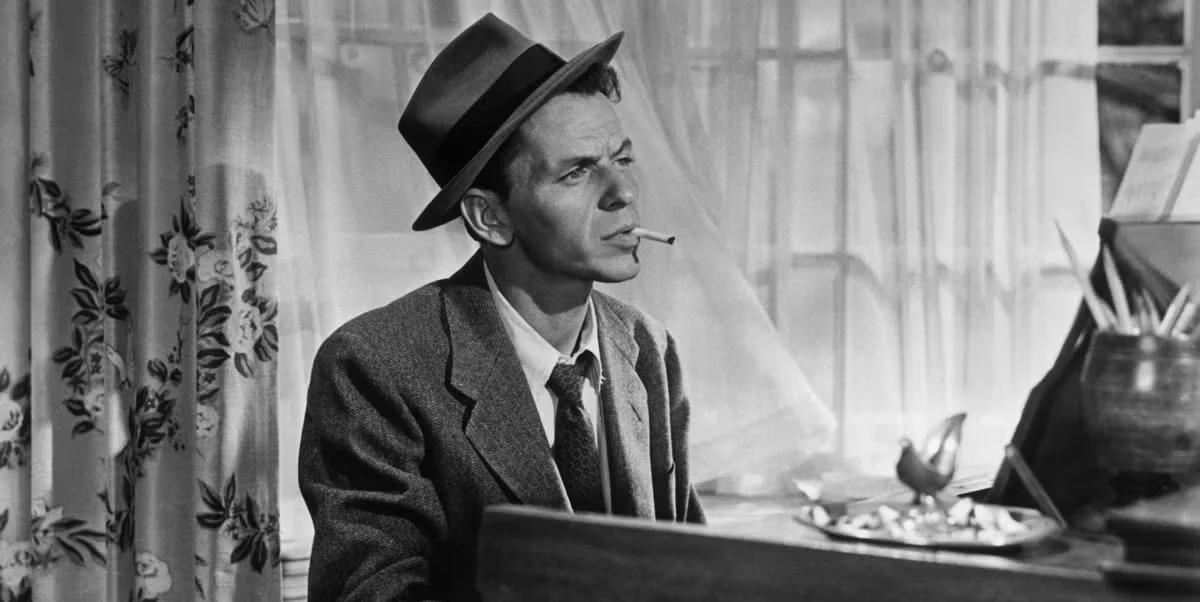
At My Way Barcelona, that connection is no coincidence. The restaurant defines itself as a space inspired by 1950s New York, with a lounge spirit, Mediterranean cuisine with international touches, signature cocktails, and an atmosphere that brings back the golden age of jazz and classic cinema. The bond with Sinatra is also part of the venue’s history: the restaurant’s own blog has already explained that the name “My Way” directly refers to the iconic song made famous by Frank Sinatra, and a historic Barcelona guide still remembers the venue as “My Way (formerly Sinatra)”.
But we like to go a step further. Here you will find verified and interesting facts about Sinatra, the origin of “My Way”, some of the keys to his cultural influence and, above all, why his legacy continues to fit so naturally in a restaurant like My Way. Because talking about frank sinatra my way is not only talking about a famous song: it is talking about a style of night, a way of walking into a room, and an experience that can still be lived today in the heart of the Gothic Quarter.

Why Frank Sinatra still fascinates
Frank Sinatra was not just a great voice. He was an exceptional mix of singer, actor, public figure, and creator of a world of his own. According to Britannica, he is considered one of the most admired and sought-after artists of the 20th century and, for many, the greatest male singer in American popular music. That importance cannot be explained by commercial success alone. It comes from the way he brought together music, stage presence, cinema, sophistication, and a very particular idea of charisma.
That is why the universe of frank sinatra my way still works so well in cultural terms. Sinatra represents an era, yes, but also a way of being in the world: impeccable, nocturnal, self-assured, and emotionally restrained. That combination is what still makes him a reference today whenever someone wants to build an experience with echoes of classic glamour, jazz, a well-served cocktail, or a restaurant that aims to offer more than just dinner.
In the case of My Way, that legacy fits especially well because it goes beyond the name itself. It is present in the Art Deco décor, in the declared inspiration of 1950s New York, in the evening cocktail culture, and in the desire to turn dining into a full evening experience. That is where the article gains strategic meaning: this is not about writing about Sinatra simply because he is a famous celebrity, but about reinforcing a brand identity that already exists and can be developed much more effectively through purposeful content.
9 things about Frank Sinatra not everyone knows
1. He nearly died the day he was born
The official chronology at sinatra.com shares a fact that is as dramatic as it is little known: Frank Sinatra was born during an extremely difficult delivery. The baby, weighing more than 13 pounds, suffered tearing and a perforated eardrum during birth, and he was not breathing when he came into the world. It was his grandmother, an experienced midwife, who managed to revive him. It is no minor detail: from his very first day, Sinatra’s biography already seemed to have the tone of legend.
2. Before becoming a star, his first major breakthrough came with the Hoboken Four
Many people remember the elegant, mature and universal Sinatra, but his first major push came in 1935 thanks to the programme Major Bowes and His Original Amateur Hour. The official chronology explains that he ended up singing with an improvised group called the Hoboken Four, formed by several hopefuls during that audition. It was his first mass showcase and an early sign that his ambition extended far beyond the local circuit.
3. His first record was not a success
This is worth remembering because it helps demystify success. In 1939, Sinatra recorded his first record with Harry James, “From The Bottom of My Heart”, and the official chronology notes that neither the song nor its B-side made the charts. It is an interesting detail because it shows an uncomfortable but useful truth: even the biggest careers often begin without an immediate triumph.
4. Bing Crosby was a decisive influence
According to Britannica, Sinatra decided as a teenager that he wanted to become a singer after listening to Bing Crosby’s recordings. This helps explain one of the keys to his style: Sinatra did not appear out of nowhere, but absorbed earlier traditions and turned them into something unmistakably his own. That blend of inheritance and identity is exactly what makes great icons memorable.
5. He won an Oscar when many believed his best years were behind him
Sinatra was not important only in music. Britannica includes among his major honours the Academy Award for Best Supporting Actor in 1954. In practice, that award confirmed his comeback and strengthened the idea that he was not just a singer with screen presence, but a performer with real weight on film. That acting dimension also explains why his name fits so naturally with spaces that combine music, cinema and staging.
6. He founded Reprise Records and changed the conversation around artistic control
One of the most interesting parts of Sinatra’s legacy has nothing to do with a specific song, but with his vision of the industry. The official Sinatra universe reminds us that in 1960 he founded Reprise Records, an especially innovative move because it opened the door for artists to have greater control over their recordings. That decision reinforced his image as an autonomous figure, something that naturally fits the philosophy later symbolised by “My Way”.
7. “My Way” was not born in the United States
This is probably the best-known detail among music lovers, but it still surprises people discovering the story for the first time. Paul Anka explained on his own website that “My Way” was adapted from a French song, “Comme d’habitude”, written by Jacques Revaux, Claude François and Gilles Thibaut. Anka saw something bigger in that melody, rewrote it with a completely different spirit, and ended up giving Sinatra one of the most recognisable songs of the 20th century.
8. Sinatra recorded “My Way” in a single take
This is one of those details that helps explain why certain songs end up surrounded by so much aura. In Paul Anka’s account, Sinatra recorded “My Way” in one take. And not only that: the same source recalls that the song remained in the UK Top 40 for 75 weeks, an extraordinary figure for the time. It is solid proof that the frank sinatra my way phenomenon is not a retrospective exaggeration, but a well-documented historical reality.
9. His legacy goes far beyond entertainment
The official GRAMMY profile does more than list his awards; it also recalls that Sinatra gave a benefit concert at Carnegie Hall in 1961 for Martin Luther King Jr., and that he was a constant supporter of Jewish causes, raising millions in bonds for Israel. Details like these balance the more stereotyped image of the character and show him as a figure with social impact, not only as an icon of elegance and nightlife.
- Key idea: Sinatra was not just a singer with one immortal song.
- What makes him enduring: voice, cinema, industry, charisma, cultural symbolism, and the ability to build a world of his own.
- What connects him with My Way: atmosphere, style, a sense of ritual, and a way of understanding the experience beyond the table.
What makes the song “My Way” so special
Talking about Sinatra without talking about “My Way” would be incomplete, but reducing him only to that song would also be unfair. Even so, one thing is undeniable: very few musical pieces have become so closely associated with an idea of identity as this one. According to Paul Anka, the song emerged at a moment when Sinatra felt that rock and roll had pushed him aside and that perhaps the time had come to retire. That sense of an ending was precisely the spark that turned a French melody into a proud, almost theatrical farewell that still feels instantly recognisable.
That explains why the search frank sinatra my way continues to carry so much semantic force. It is not only a famous song, but a complete narrative: a mature artist, aware of the passing of time, singing with confidence and without easy sentimentality. In that sense, “My Way” is not just a ballad; it is a statement of tone.
It also explains why its name works so well for a lounge restaurant. “My Way” suggests personality, ritual, judgement and an experience with its own signature. In fact, My Way Barcelona has already explained on its blog that the name of the venue refers to that song and to that way of being in the world. This article can build on that foundation, but with a stronger, better documented and less repetitive approach than a simple musical reference.

The connection between Sinatra and My Way Barcelona
This is the most important part for the brand: it is not enough to mention Sinatra, the reference has to make sense. And at My Way, it does. The official website presents the restaurant as a place where “you will travel back in time to 1950s New York”. Another article on the restaurant’s own blog also speaks about the glamour of that era, the influence of the Rat Pack and an Art Deco atmosphere designed to turn dinner into an experience with identity, not just another night out.
The connection is also historical. Barcelona Guide still refers to the venue as “My Way (formerly Sinatra)”, a valuable detail because it adds narrative continuity: Sinatra is not an improvised wink, but a layer of identity associated with the place for years.
Today, that heritage translates into something very concrete: a Mediterranean dining proposal with international touches, a cosmopolitan room, evening cocktails from 11 pm, jazz music and fragments of classic cinema that reinforce the experience. If someone is looking for a restaurant in Barcelona where the Sinatra reference is more than decorative, My Way has real arguments to support it.
If what draws you to Sinatra is the combination of elegance, staging, music, nightlife and personality, then it makes sense that the next step is not just to keep reading, but to discover the rooms at My Way and explore its Mediterranean menu.
If you like Sinatra, this is how you should experience My Way
A strong cultural reference is not explained: it is embodied. If you are going to bring Sinatra into the realm of experience, the logical thing is to do it well. At My Way, that happens through several layers working together:
- Arrive with time to spare. The space asks for pause. It is not designed for a rushed dinner, but for a full evening.
- Look at the room, not only the menu. The 1950s New York inspiration and the Art Deco décor are part of the experience.
- Leave room for the night to unfold. My Way does not end in the kitchen; its cocktail culture and lounge atmosphere are part of the plan.
- Understand the cinematic reference. The restaurant’s own blog speaks about fragments of classic films and an aesthetic strongly linked to that era.
- Reserve as if you were reserving an atmosphere, not just a table. That is the best way to truly connect with the spirit of the place.
If you already knew Sinatra’s story, the plan gains more layers. And if you arrived here without knowing much about him, even better: now you understand why the name frank sinatra my way carries so much symbolic strength and why it fits perfectly into a Barcelonian night with a New York soul.
If you feel like following that thread a little further, you can also read more anecdotes about Frank Sinatra or go back to the origin of the naming in “My Way” lounge restaurant in Barcelona. And if you would rather move straight from reading to the experience, the recommendation is simple: explore the menu, discover the rooms and reserve a night with jazz, classic cinema on screen and an atmosphere that does justice to the tribute.
Final CTA: If you want to discover the most lounge-driven, cinematic and New York-inspired side of My Way Barcelona, this is the right moment to get to know the space, let yourself be carried by the music and enjoy an evening with real personality.
Frequently asked questions
What does “My Way” mean in Frank Sinatra’s story?
It is one of the most emblematic songs associated with him, popularised by Sinatra in 1969 and written in English by Paul Anka from the French melody of “Comme d’habitude”.
Did Frank Sinatra write “My Way”?
Not exactly. The English version was written by Paul Anka based on an earlier French song composed by Claude François, Jacques Revaux and Gilles Thibaut. Sinatra was the one who turned it into one of the most recognisable performances in popular music.
What does Frank Sinatra have to do with My Way Barcelona?
Much more than a simple musical reference. The restaurant’s name directly refers to the song “My Way”, and the experience of the venue is inspired by 1950s New York, lounge glamour, jazz and an aesthetic very close to Sinatra’s world.
Is it true that the restaurant used to be called Sinatra?
The brand explicitly works around the tribute to Frank Sinatra, and a historical Barcelona guide still refers to the venue as “My Way (formerly Sinatra)”, which reinforces that symbolic continuity.
Sources
- Frank Sinatra official timeline
- Frank Sinatra official timeline: Recording “My Way”
- GRAMMY: Frank Sinatra artist profile
- Britannica: Frank Sinatra biography
- Paul Anka: Behind The Song “My Way”
- Official My Way Barcelona website
- “My Way” lounge restaurant in Barcelona
- 6 surprising anecdotes from the life of Frank Sinatra
- Barcelona Guide: My Way (formerly Sinatra)
