Providence, 1872: eating when everything is closed
The protagonist is Walter Scott (1841-1924), from Providence, Rhode Island. Since the mid-1850s, he sold candy, fruit, and newspapers in the commercial districts of the city, first with a basket and then with a cart that allowed him to add hot coffee.
Scott soon detected a market that no one was serving. Restaurants in Providence closed around eight in the evening, but workshops, printing houses, and newspaper offices worked at night. There were hundreds of people working at hours when, simply put, there was no possibility of having dinner.
In 1872, he took the definitive step, left his job, bought a horse, and converted an old freight wagon into a vehicle designed to transport goods, not people, in the first night lunch wagon in history. He opened windows on the sides to serve from the street and parked it in front of the Providence Journal. His hours matched those of his customers: from dusk until four in the morning.
He served ham sandwiches, boiled eggs with bread, and slices of pie for a few cents. There were no tables or chairs or protection from the rain. There was hot food at an impossible hour, which was exactly what was needed.
From cart to industry: how the wagon became architecture
The idea worked and was copied. The subsequent chronology explains why the diner ended up having such a recognizable shape:
-
1883: Ruel B. Jones leaves the Providence police and commissions a local carriage maker to design the first cart specifically for this business, instead of converting a freight one.
-
1887: commercial manufacturing of lunch wagons begins in Worcester, Massachusetts, led by Thomas Buckley, known for his "White House Cafe" models.
-
1893: Charles Palmer obtains the first patent for the format, which he markets as the "Night-Lunch Wagon".
-
1920s: the carts become fixed, gain interior seating, and are renamed dining cars. The abbreviation becomes common around 1924, and the word diner is born.
This genealogy explains the detail that most defines the genre: the diner is architecture where form strictly follows function. The long counter exists because the original space was narrow and elongated. The steel and washable surfaces exist because they had to be cleaned quickly between shifts. The booths appear when the establishment stops moving and can afford depth. None of this was designed to be beautiful; it turned out beautiful because it was honest.
From handcrafted wagon to industry: when the diner became steel
There is a second leap, less known than Walter Scott's, that explains why the diner ended up having the shiny appearance we associate with the 1950s. In the early 20th century, the first specialized manufacturers emerged: the Worcester Lunch Car Company was founded in Worcester, Massachusetts, in 1906, and would go on to build 651 units between that date and 1961. Shortly thereafter, Jerry O’Mahony, born in Bayonne, New Jersey, set up his own company in Elizabeth, and between 1917 and 1952 manufactured about 2,000 more units, fully prefabricated and transported by road or rail to their final location.
The decisive change comes with the Streamline Moderne aesthetic of the 1930s, the same visual language that was redesigning automobiles, appliances, and even fashion in that decade: curved lines, a sense of speed, and new industrial materials. The diners of those years incorporated enameled porcelain, Formica, and, above all, stainless steel, along with new shapes like rounded ends or the gabled roof that allowed for ventilation and natural light. At the peak of the phenomenon, in the 1950s, it is estimated that about 6,000 diners operated simultaneously in the United States, concentrated mainly in the industrial Northeast.
That is to say, the metallic shine that we now read as the aesthetic of the 50s is not a decorative whim of that decade, but the result of twenty years of prior industrial refinement. By the time the golden years of the diner arrived, the design was already resolved; what changed was the scale.
What the diner taught modern dining
A century and a half later, several of its decisions remain good decisions:
-
Serve when others close. The diner was born from a schedule, not a menu.
-
The counter as a stage. Watching the person serving you completely changes the experience of waiting.
-
Sincere materials. The shine of metal and the chromatic contrast were not decoration: they were function that ended up being style.
-
Democracy at the table. From the beginning, the same place served printing workers, theatergoers, and those simply passing by in the early morning.
A business built by those who had no other entry point
There is a pattern that repeats in several of the proper names of this story and deserves to be highlighted; the diner was, from the beginning, a business of people starting from the bottom. Walter Scott sold newspapers with a basket before he had a cart. Ruel B. Jones left the police to set up his own. And one of the longest-running diners in Providence, the Haven family diner, was founded in 1893 by Anne Philomena Haven, a widowed immigrant who invested her late husband's life insurance money into the business.
This genealogy explains why the diner never resembled a formal restaurant: it was born as a pathway for those without capital, surname, or time to waste. It democratized both the clientele and who could stand on the other side of the counter.
It is a lesson that transcends the furniture and neon: the diner succeeded because it solved a real need to eat well, at an impossible hour, without costing a fortune before becoming an aesthetic. Any establishment that today recovers that visual language inherits, whether they want to or not, that underlying demand.
The 50s, or when a solution became a symbol
The decade we now associate with the diner was actually its moment of cultural consecration, not invention. With the post-war era came mass production, new materials, the expansion of the highway, and a middle class eager to go out. The diner was already invented: what the 50s did was turn it into an image, a promise, and an anticipatory nostalgia.
That is why the aesthetic of that decade still works so well. It is not an empty set: it is the final form of a very practical idea that had been perfected for eighty years.
From Providence to the Gothic Quarter
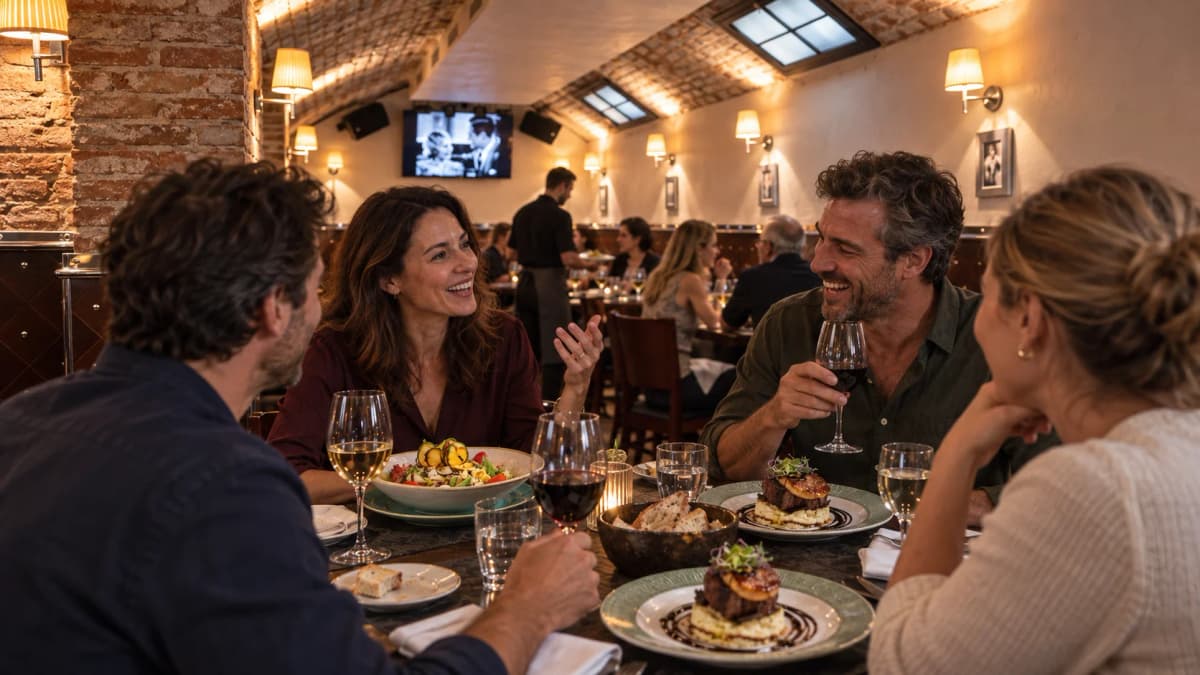
My Way picks up that thread and translates it to Barcelona with its own interpretation. The atmosphere draws from the American imagery of the 1950s; the cuisine, on the other hand, is Mediterranean and Spanish, with a culinary ambition that goes beyond the nod. And the hours almost unconsciously maintain the foundational spirit of Walter Scott, here dinner is served late, when the city has slowed down and the historic center changes tone.
It is an uncommon crossing: the visual warmth of a specific era, the product of a different territory, and a 19th-century square just around the corner.
Reserve your table at My Way, at Carrer de les Heures 4-10, and see what happens when the American 50s dine Mediterranean.
Sources
- Academic project «The Evolution of the American Diner» (University of Southern California, Scalar platform)
- ArtInRuins — The History of Diner Cars & Lunch Wagons (Providence heritage archive)
- Chronology of patents and commercial manufacturing of the lunch wagon
- Chowhound — How Old School Lunch Wagons Paved The Way For Modern Diners
- Wikipedia — Jerry O’Mahony Diner Company: production and industrial chronology
