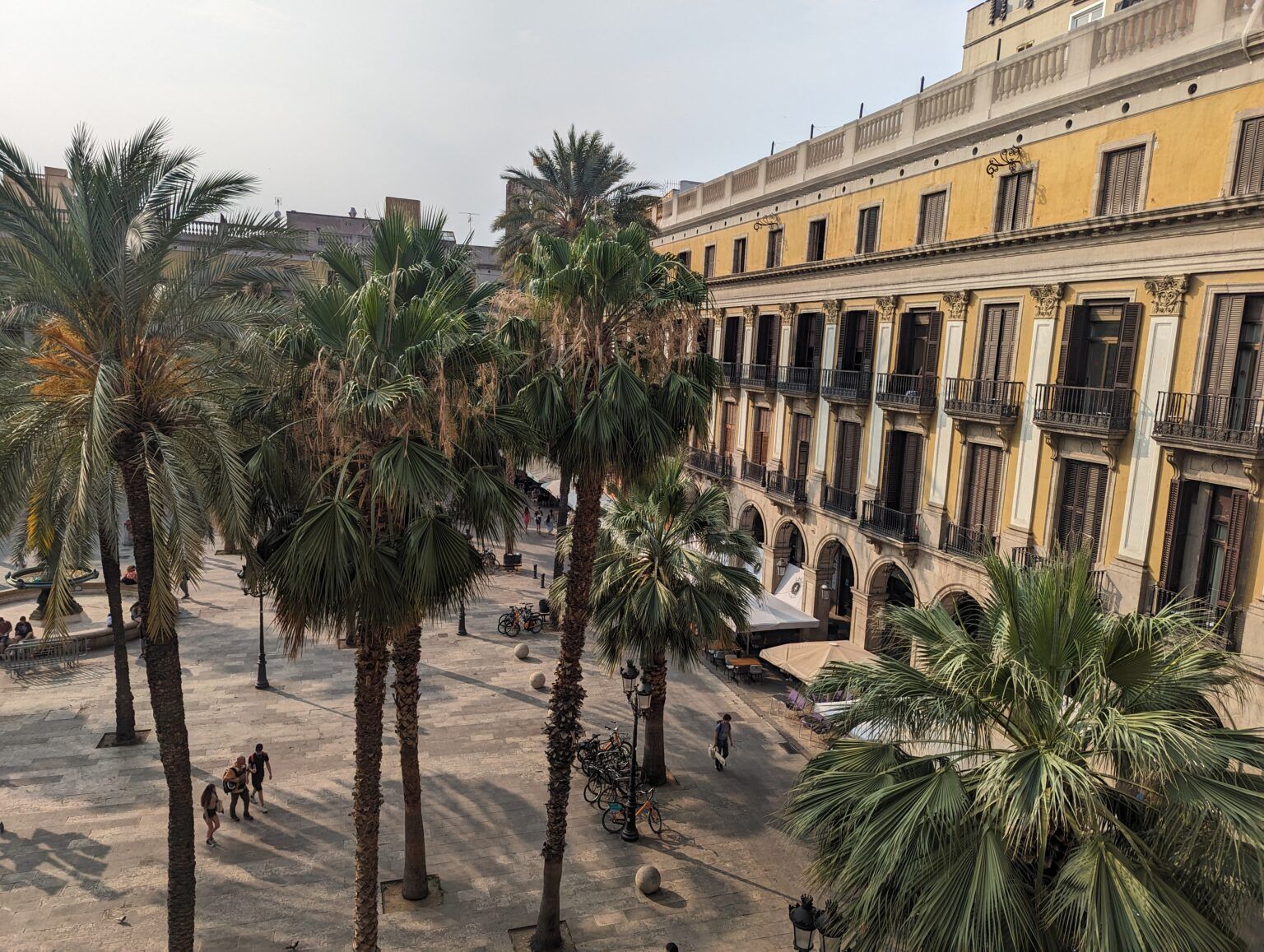
The Royal Square of Barcelona: A Cosmopolitan Landmark
The Royal Square (Plaza Real) is one of the most iconic locations in the city of Barcelona, welcoming visitors from all over the world every year. It’s a place where you can feel the cosmopolitan and Mediterranean essence of the Catalan capital and its artistic legacy. While many people know about its existence, few truly understand the history behind it. Today’s article uncovers various curiosities, peculiarities, and the history of the enigmatic Royal Square of Barcelona.
The Capuchin Legacy
Since 1822, the Italian order of Capuchin monks established a convent in the Gothic Quarter. However, in 1835, this place of worship was dissolved due to the disentailment of Mendizábal. The land was auctioned to create a new space for the city. Shortly thereafter, various architects from prestigious schools, such as La Llotja, submitted proposals for the site, including the construction of a theatre. However, this idea was abandoned due to its proximity to the Liceu opera house.
The Name "Royal"
The square was named after King Ferdinand VII, intending to create a space in Barcelona that honored his figure. The monarch also planned to erect a statue of himself as a symbol of his absolutist rule in Catalonia. However, due to his unpopularity, the statue project was abandoned shortly after his death, and a fountain (Font de les Tres Gràcies) was built in its place.
The Sister Square of the Royal Square
In 1848, architect Daniel Molina oversaw the restructuring of Barcelona's Royal Square. Comparing its design to Madrid’s Plaza Mayor, one can find many similarities in the elements that comprise both spaces. Symbolically, the squares also share commonalities, especially in the historical events they hosted, such as the proclamation of the Second Spanish Republic.
A Tribute to the Discovery of the New World
In the Royal Square, you can find coats of arms and busts of notable Spanish explorers and navigators who ventured to the New World (the conquest of the Americas) in search of adventure and wealth. The square’s lampposts, designed by modernist architect Antoni Gaudí, were added in 1879 to complement the composition of the Font de les Tres Gràcies. These lampposts are particularly notable for their naturalistic forms, which resemble coiled serpents. The upper part evokes the winged helmet of Hermes or Mercury, the messenger of the gods.
The Oasis of Barcelona
This is another name Barcelonans use to refer to the Royal Square. Today, the area is a bustling hub of nightlife that contrasts with other parts of the city. Around the square, you’ll find palm trees juxtaposed with the fountain and lampposts, creating an open space where many restaurants and businesses are nestled under its arcades.
It is one of the few enclosed and porticoed squares in Barcelona, featuring a rectangular layout surrounded by neoclassical buildings. We hope this brief article inspires you to discover or rediscover the hidden spaces of the city and enjoy the unique atmosphere that surrounds this historic square.
